Look: The Graphic Language
of Henry Steiner
石漢瑞的圖語世界
Look: The Graphic Language of Henry Steiner is an exhibition presented by the Centre for Communication Design at Hong Kong Design Institute (HKDI). As co-curators, my partner and I led a core team of four through all stages of development—from establishing the curatorial framework to delivering the final exhibition.
Our interpretive strategy centres on the learner experience, employing a coherent voice and layered messaging tailored to diverse audiences. Recognising that visitors bring varying levels of familiarity with Henry Steiner’s work, we conducted a front-end evaluation to refine our interpretive materials. This comprehensive approach encompasses extended text labels, an exhibition catalogue, motion graphics, a teaser video, an interactive public engagement area, and a dedicated website.

Image Description from left to right: Inside a glass vitrine, an iPad with an animated HSBC logo sits alongside archival documents, offering an interpretation of the design intention of the logo symbol. At centre, a subsection panel titled “Look further” in English and Chinese presents extended contextual prompts, encouraging deeper engagement with the artifacts. At right, a concluding exhibition panel states “Looking is an active process of questioning,” framing the exhibition’s core philosophy.


Image Description from left to right: Student visitors, masked and attentive to the exhibition curator-led tour, lean toward a glass vitrine filled with design artifacts. At the centre, bilingual text panels frame the ‘Systems’ section introduction; words in English and Chinese flow across dark panels above illuminated glass cases. At right, a close-up of the vitrine surface shows layered artifacts—a three-dimensional HSBC logo model, photographs of HSBC signages across different cities, and HSBC brand identity guidelines on display.


Image Description from left to right: Inside a glass vitrine, an iPad with an animated HSBC logo sits alongside archival documents and sketches, offering an interpretation of the design intention of the logo symbol. At centre, a subsection panel titled “Look further” in English and Chinese presents extended contextual prompts, encouraging deeper engagement with the artifacts. At right, a concluding exhibition panel states “Looking is an active process of questioning,” framing the exhibition’s core philosophy.


Public engagement
The public engagement area invites visitors to experience Steiner’s distinctive approach to storytelling through hands-on collages using everyday objects. Participants are encouraged to share their creations on Instagram, extending the exhibition’s reach beyond the physical space.

Image Description from left to right: A public engagement area invites visitors to "Create your object stories" through their smartphones. Two children stand before a white wall displaying everyday objects—a telephone, metronome, Japanese kendama, chess pieces—arranged across two shelves. At centre, a subsection panel titled "Look further" provides contextual information and a QR code. At right, a concluding panel branded with "#henrysteinerobjectstories" invites visitors to select everyday objects and create photo stories inspired by Henry Steiner’s design narrative approach.
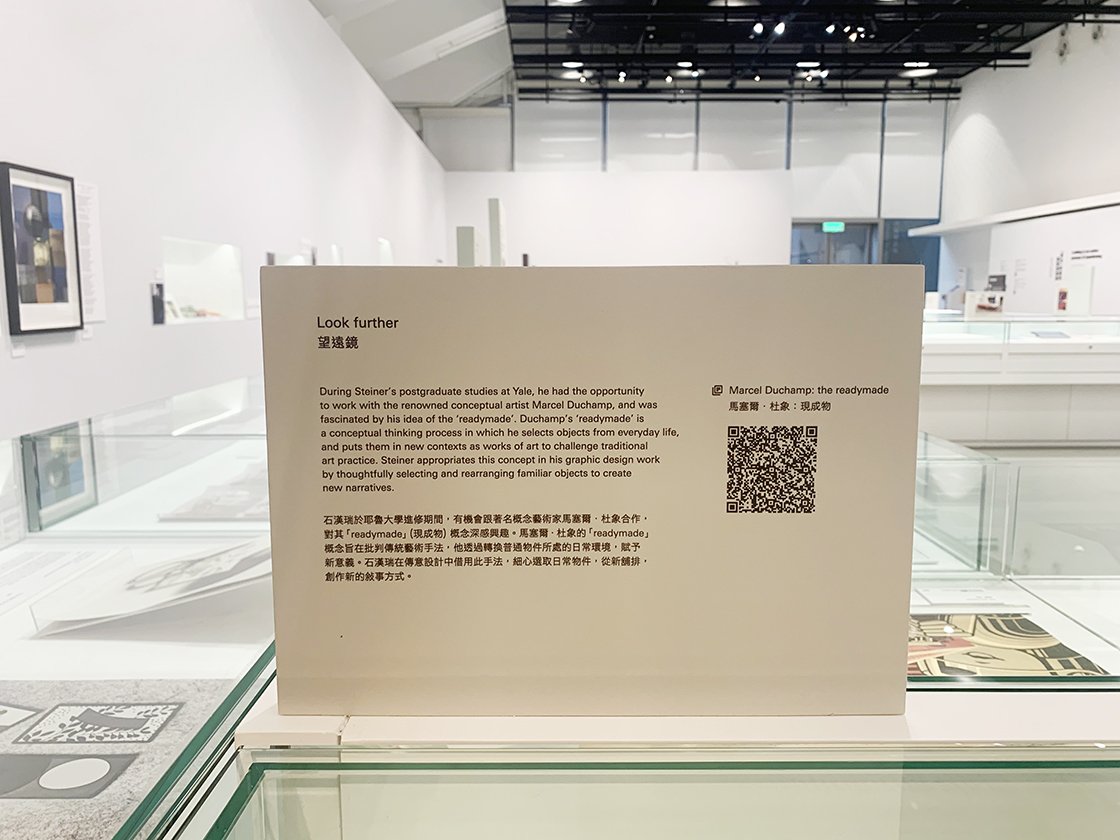


Image Description from left to right: At left, a visitor is creating her ‘object stories’ using the smartphone in the public engagement photo booth area. At centre, designer Henry Steiner is curious about the selections of everyday objects. At right, a social media post shows a red ceramic mug photographed against a curved white surface, accompanied by a comment: “What makes exhibitions intriguing? It gives the audiences an opportunity to experience how a designer creates.”


Image Description from left to right: At left, a visitor wears a ‘wearable eye tracker’ to observe the exhibition. The device decodes head and eye movements to generate insights about what captures attention. At the centre, a screen capture shows digital visualisation from the eye tracker results in heat-mapped soft green to orange tones, indicating low to medium levels of visual attention across the display surface. At right, the same visualisation displays Gaze Plots as numbered circles on the image, revealing the location and duration of eye movements—the attention paths of visitors across the exhibition.


Video Description: A teaser video for the exhibition. Henry Steiner explains his ‘looking’ approach, observing vernacular Chinese typography as he strolls through the Sai Ying Pun neighbourhood.
Photo credit: HKDI Gallery
Motion-graphic credit: Centre for Communication Design, HKDI
Video: Centre for Communication Design, HKDI